Music at Baskahegan Lake

It was a rainy, gloomy morning at camp. We had all arrived at different times the night before. My trip from New York to Maine by air was the most direct. Harv came by bus via Albany and Arnie and Bob drove 700 plus miles from western New York. Our first day at camp looked downright crappy. All our pent-up expectations of fishing and hiking during our short stay were weighed down under a cloud of dense fog.

Being the optimist that I am, I went ahead and organized, with Greg’s help, a cookout at Baskahegan Lake — and some fishing if the weather permitted. I could not let those Harry Hots, Don and Bob’s Hot Sauce and Genessee beer–all our teenage favorites transported direct from Rochester in the back of the car on that 700-mile ride–go to waste. With intermittent rain predicted throughout the day, we bundled up for wet conditions and headed off late morning. We followed in the Bronco as Greg led the way, trailering his boat loaded down with cooking supplies, fishing gear and of course our luncheon special.

The boat launch at Baskahegan is nonexistent – one wades into the water to embark. Wet in the feet already, I felt a mix of regret and foreboding that I had talked everyone into spending the day on the water. Greg had a campsite in mind for lunch and found his way across the broad reaches of the lake without GPS or a compass. As we approached the shore in a light fog, a couple of kayaks appeared—one a traditional yellow fiberglass and the other an unusual handmade one of varnished wood—and they just as quickly disappeared.

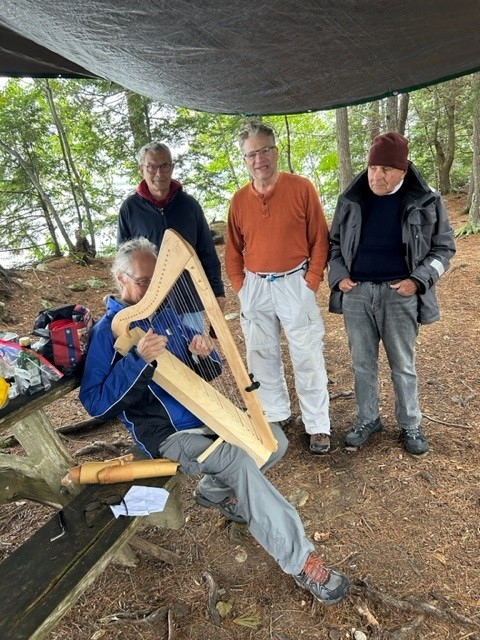
After we landed, some campers on shore, senior fellows like us, approached with friendly greetings. We chatted and learned they were from Massachusetts and, also like us, had known each other since high school. They were settled in at the campsite for an overnight, having rigged up tents spread between the trees. Underneath was cooking gear and hammocks for sleeping and, unexpectedly, a wooden harp, propped up against a small bench.

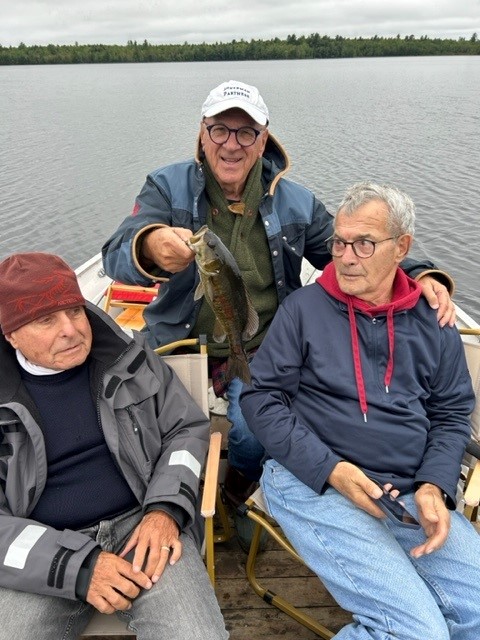
One of the campers picked up the harp and began to play for us. The gentle notes were delightful and so incongruous to the surroundings I suddenly felt transported back to a chamber music concert at Boscobel House on the Hudson. Yet here we were out in the middle of nowhere enjoying classical music with some new friends. Miraculously, the weather completely cleared up after lunch. We fished at a former dam, one of Greg’s secret fishing holes, and the guys got into a slew of fish. I caught a small mouth bass and they had their fill of sunfish, bass and carp. All in all, it was a grand day of boating, fishing, lunching and music on Lake Baskahegan.
harp-2.jpg

Fishing the Morning

Support The Mountain Messenger by purchasing Lenny Ackerman’s collection of Here Back East columns, Fishing the Morning!

Fishing the Morning Jacket

End of Summer Visit to New York City

Starting in the early 1960s and for years afterward during the summer months, we fled New York City for the Hamptons at every opportunity. I could not be bribed into staying in New York City for a long holiday weekend. I was drawn to the country with its open spaces, white beaches, and fresh air. In the 1970s, I finally convinced my family to move out to the Hamptons permanently.

I left corporate law and started a country practice of my own for real estate, family law and some litigation. Today, some 50 years later, I still have my East Hampton firm, but surprisingly, I am spending Labor Day weekend in New York City, at the U.S. Open Tennis Championships, Arthur Ashe stadium. Who would’ve thought? Change in direction comes to all of us. At this stage of my life, I am more open to new adventures. Some may not believe that going to a grand slam tennis tournament is adventuresome, but it is an exciting experience and an outcome of my renewed enthusiasm to play tennis again after what seems like a lifetime since I played in high school.

I am always driven to look for something new in life. I try to travel outside the parameters of what is cozy and secure. It is reflected in my professional work when I lean into an argument that was a dissent in a previous case. I look to redefine precedents to reflect current times and needs. I speak often of living in the present. Every day is a new opportunity to venture out– beyond the Hamptons and even New York. Maine has been a regular source of adventure for the past five years. Exploring the backwoods and lakes in Washington and Aroostook counties in my 1973 Series 3 Defender. Fishing the morning on Spudnick Lake. Swimming off my dock in the cove.

I write these columns to record my experiences on paper. Painting and sketching along the shore and in the wilderness are other means of adventure and self-expression. I am indeed fortunate to have the companionship and family support that allow me to do these things. I am mindful every day of those who are unable or unwilling to venture out. The barriers are often money or family responsibilities. Yet there is some adventure for everyone.

Leaving Arthur Ashe stadium today we drove through Flushing Meadows in Queens. There were hundreds of families picnicking, playing volleyball and soccer. Predominantly Hispanic from the music wafting throughout, this community of New Yorkers found their weekend adventures, and relaxation. A Sunday in the park, free of workday demands, some on blankets basking in the sun, babies quiet in their mother’s arms, their own country landscape.

A Change of Scene

Next week is my last scheduled trip north to camp.  A planned visit with my high school friends, less one, is something I have looked forward to each year since 2020, when we all first ventured as a group to camp for a sleepaway. This year it is guys only. No plans for Wheaton fishing guides.  Only local fishing with Greg, exploring around the lake in my 1950s motorboat, steak, and lobster on the grill and plenty of catching up.  I am planning a walk to Sucker Lake and a picnic on the island.  Bob likes to fish from the dock.  Arnie enjoys the evening campfire.  Harv always serves us the best of wines.  And I just enjoy hosting my buddies.  This year our friend Jer decided to rest his back, avoiding the long drive from Wellesley, Mass.  We will miss him.

There is much to look forward to, however when I think about the usually pleasant drive north to camp from Bangor airport, I feel some trepidation.  According to the Houlton Pioneer Times, our local weekly newspaper and a reliable source, a neo-Nazi training ground is being built in Springfield, a small community a mere 30 minutes south of Danforth, my camp home.  This news is alarming.  Springfield, population 400, is known for its local Labor Day Fairgrounds.  It is a typical rural Maine town along Route 169 with a gas station, a roadside pizza stand and, aside from the fairgrounds, not much more.  Now it appears to be the setting for extremists to indoctrinate their followers in weapon use and hateful ideology.  It is a disturbing development, yet the state of Maine has no laws prohibiting paramilitary training activities—an invitation to these groups to form their camps there. According to the Houlton article, local legislators are moving to enact appropriate state laws to prohibit such activities.  As I drive through Springfield next week, I will be conscious of the extremism taking root in my neck of the woods.  Will Nazi flags become part of the scenery? Will the last 30 picturesque miles to camp be blighted by symbols of anti-Semitism?  Who would’ve thought!  Once again it was a small weekly paper, published in the heart of the wilderness, that brought important news to my attention.  Local reporting is best at sorting out the good and bad in our beautiful Maine.

Author’s Night

This was my second time participating in the East Hampton Library’s fundraising event, called “Author’s Night”.  We were all under a large white tent in Herrick Park on a hot and humid Saturday afternoon.  From day trippers to locals to weekenders and fulltime residents, they all came to buy books and meet well-known authors such as Robert Caro, the imminent historian, and Tina Brown, former editor of the New Yorker magazine–and me, a not-yet-famous writer of newspaper columns.  The author table placement was alphabetical so just as I had been assigned to the front row in grammar school, there I was, first in the line, seated behind my stack of books to sell, as the backed-up crowd filed in at 5:00p.m. sharp.  The parade started at my table–and continued past it.  My loyal friends and colleagues, nowhere in sight, were just getting out of their swim trunks at home right about that time.  Many of the early visitors had traveled from “western” towns like Hampton Bays and Southampton.  Some pick up my book and scan a few pages or read the cover flap.  It is of no interest, nor am I, a sweaty, 80-plus-year-old guy with his book “Fishing the Morning.”  Every face seems to have the same question: “Who and what is this guy about?”  A brief chat: “Is this a book about fishing?” “Not really,” I answer.  “It is a collection of my columns that I write for…” and before I can finish, they are off to the next table.  For the next 15 minutes or so I suck on my water bottle and wipe my face from the sweltering humidity and embarrassment that I have not sold a single book.  Next to me is Jim Acosta, the well-known journalist, highly regarded by many who watch CNN.  All the liberals stop to shake his hand.  50-50 buy his book.  And then finally to my rescue they come—a colleague, Amanda, and clients from town who remember a closing or two.  Then local politicians, some who already have my vote and others who will in the future. My stack of books is shrinking.  A few Rochester natives stop by to reminisce and buy books.  Of course, my kids show up with support from their friends and a few more books move off the table.  My neighbor Jim Acosta peers over to see how many I have sold and asks if I would like a beer to cool down.  “Yes, thanks,” I say, and his girlfriend, standing by, goes in search of a couple of cold bottles for us.   We both glance at our watches to gauge how much longer we need to sit there soliciting book buyers.  Jim has had an easier time since he is so well-known from television.  I’m a “minor” celebrity only among my satisfied clients and friends from over 50-plus years of living here.  As the closing bell was about to ring, Patti helped me box up my remaining, unsold books.  It was a good day—17 copies sold, all the proceeds to benefit the East Hampton Library.  As I walked to the long-term parking lot, I thought about next year.  Maybe a book just about my fishing experiences?  I pulled out of my parking space and a book-buying friend across the way shouted out “Hey Lenny!” and gave me a thumbs up. Yup – a good day. 

August in the Hamptons

It is that time of year here in the Hamptons when movie stars, entertainers, tennis champions, finance wizards, famous authors, tech moguls, politicians, twenty-somethings converging on share houses, European jetsetters, and retirees from as far as Israel, all come to feast on the perfect ocean beaches along eastern Long Island.  For those of us without a private chef, the restaurants are overcrowded, and the roadways are jammed with cars and trucks from early morning on the only single lane highway going east and west, until late in the evening.  The private clubs are busier than usual.  The side streets are clogged with runners and cyclists.  Navigating the back roads is a dodge.  Yet for all the traffic, celebrity sightings, parties every night, the sun rises early and the moon sets.  Kids will be returning from camp.  The school custodians will start readying the classrooms.  The traffic cops will have run out of blank parking tickets by now.  The lifeguards at Main Beach will have tired of shooing bathers out of the water because someone thought they saw a shark.  The local store clerks will have lost their patience with the long lines at Citarella.  Marcello at Candy Kitchen will have let his beard grow a bit longer. The refuse trucks that usually make weekly trips to the landfill will now be transporting bi-weekly.  A water shortage will be declared.  Lawn sprinklers will be shut down.  The pool heaters will be turned off for the rest of the season.  The traditional fundraising events—Author’s Night, Artists & Writers softball game, Guild Hall—and the annual house parties will draw to a close.  Scorching New York City sidewalks will force even the anti-Hamptonites to bus their way out to a sofa at a friend’s rental.  The city is left lopsided with the balance shifting over the next few weeks.  The scent of freshly picked corn and green beans at the farmstand in Wainscott is a simple reminder of what draws the world here.   I wake up as early as I can, at sunrise, before the helicopters carrying yet more weekenders swirl over our home.  The New York Times delivered early.  The morning coffee overlooking Jones Cove.  It is a paradise—a brief one.

Homewater

It was a bit overcast with a threat of rain when late morning Ted, Greg and I pushed off a steep embankment near Bancroft Road in Danforth.  My Grand Lake canoe had not been in the water yet this season and I was eager to cast the morning.  The wind came from the southwest and with the high water the current took us immediately downstream.  I stood up in the bow and unleashed my five-weight, nine-foot rod toward the bank.  A yellow popper drifted on the end of my tippet and a small bass took to it.  It was a fine start.  The river ran softly and the eagle that soared along with us called out its song of happiness.  No one was fishing from the bank, nor were there other floats on the water—only us in the quiet of the river.  Fishing the morning on a float was reminiscent of trips to Labrador, the Restigouche and the Miramichi, all in Canada.  This was my Homewater.  I was not a visitor or vacationer.  Greg’s hard work in finding a landing and in fact creating one, launching my canoe and directing us to the best pools for fishing made the day perfect.  I often say to friends “it is the journey not the destination.”  Here it was the destination—a place near my camp where I had peace and quiet.  We fished until we came to a bypass of sorts where the river went off and created a 20-foot-wide mini-stream.  Pushing through Greg found a spot to hold the canoe steady while I stepped out to fish a pool created by the confluence of another small stream.  The overhang from the trees gave me just enough room to backcast without sacrificing a fly.  The fish were plentiful. Ted had me using streamers as well as top-of-the-water flies.  Wet feet and all I cast away with only one thought in mind:  I could come back to my homewater any time –no reservations needed. 

Teachers

Last week my friend from Rochester, Arnie, forwarded the obituary of Pincus Cohen, one of the last surviving teachers from our Ben Franklin High School days back in the late 1950s.  Mr. Cohen taught Spanish during our time there and subsequently went on to become high school principal.  I did not have Mr. Pincus as a teacher since I took German as a second language, naively believing that the Yiddish spoken at home would help me with the course. The notice of Mr. Pincus’s death led to a feature article in the Rochester Democrat and Chronicle reminding readers of the time when, as principal, Mr. Pincus took out an ad in the paper to recognize the students who made the honor roll.  He said there was always press coverage when someone does something wrong, so it was time to acknowledge those young people who work quietly and diligently doing something right.  He paid for the ad himself.  The $100 expenditure sparked a flurry of national interest and brought brief fame to my alma mater. 

In subsequent years the school as we knew it closed, reopening as a cooperative vocational institute.  No longer was it the hotbed of youth from diverse backgrounds –Black, Italian, Jewish and many others—that I remembered from my teenage years.  Extracurriculars were sports, journalism and music and graduates attended Harvard, Yale, Penn and various state schools throughout the region.  Several of my class became doctors and lawyers.  Some obtained PhDs and went on to careers in academia.

We never gave enough credit to the teachers who guided us.  Like Mr. Pincus there were several standouts.  Homeroom teacher Mr. McCormick introduced me to the New York Times which I still read dutifully every day.  There were sports coaches who went above and beyond for the athletes among us. For those of us who did not have help from parents with limited education, teachers were the surrogates to whom we went for advice, particularly when it came to the most important decision of our young lives: what to do after high school graduation.  Ray Iman was a history teacher who wore Brooks Brothers suits to class every day and took several of us under his wing, mentoring us through the college selection and application process.  He sat a few of us down in the front row of desks in the classroom after everyone else had run out and described for us what life had to offer if we worked hard, played fairly and stayed out of trouble.  But it wasn’t the same for everyone.  I remember the story of a sophomore girl in my homeroom who had stopped coming to class. The rumor was that she was pregnant.  Back then, being an unwed mother was a scandal and unacceptable in society.  Her boyfriend, presumably the father, experienced no consequences.  As I recall, she was an outstanding student.  Mr. McCormick gave us a short lecture about choices and without mentioning her name talked about how making a wrong turn can change your life forever.  That talk stayed with me. There are lost opportunities and opportunities lost.  Teachers made the difference for many of us. In hindsight, things might have been different for her if she had been mentored, the way the boys were.  But girls were steered toward marriage and motherhood. She never returned to school.

Blueberry Fair

During the last week of July, there is an outdoor marketplace in Kennebunk called the Annual Blueberry and Craft Fair.  I attended this year for the first time as a “vendor” and spent a sunny Saturday on the tree-shaded lawn of the First Parish Unitarian Universalist Church, the event sponsor.  I arrived early to arrange my fold-out card table with an assortment of my watercolor paintings and copies of my new book, Fishing the Morning.  I had my kids and Patti with me, and Brooke and Billy helped set up the table display very professionally ala Peter Marino (where Brooke works as an interior decorator).  I brought my newspaper and a book in case it was slow, but the crowd grew quickly.  I had an ideal location, adjacent to the local library which was holding their annual book fair at the same time.  The shoppers coming from the library had to pass me before making their way to the tables and tented booths at the craft fair.  There was an interesting assortment of browsers: young, old, retirees, college students, children, visiting family and friends and of course all the regulars who attend year after year.  My first buyers were two youngsters who were drawn to the title of my book and immediately charged into questioning me for the best fishing locations in Kennebunk.  Well, I had to be on my toes for these kids. They wanted to know the where, the when and the how about fishing the morning in Kennebunk – a place I have never fished.  Well I took the boys aside and suggested a couple of places that I had scouted to sketch some of my paintings—an area at the entrance to the Kennebunk River with the tide coming in.  I seemed to have satisfied them such that they asked their mom to buy my book.  I explained to her that the book was a compilation of columns about a lot of things not only fishing.  The boys didn’t care—they were already scanning my fishing paintings and questioning me about each of them as to the type of fish and where I caught them.  The boys were sold and their mom had no choice but to buy my book.  I threw in a painting of a trout as a bonus.  Next were some women visiting from western New York.  One picked up my book and saw that I was from Rochester.  That was enough for them.  A book sale and a Maine painting of Cape Porpoise.  The fact that I was both the author and painter required for each sale a personal handwritten note and signature on the item sold.  Later, a youngster standing back from the numerous browsers finally asked if I had anything for $5.00.  I had been selling everything for $20.00 but said “Of course!” It was the end of the day, and I was ready to fold up my operation.  I offered her any painting left.  She carefully looked through my entire inventory—I sold more than I ever expected so there was not much left—but she found a touching piece I had painted from the deck of our house in Kennebunk of sailboats swaying in a gentle breeze at high tide.  Just as we were closing the deal, her mother and aunt came over to round the youngster up to go home.  Hearing about our transaction, the mom bought my book and the aunt a painting.  It was a trifecta of sales.  I never finished my newspaper and the book I brought never made it out of my tote.  We toasted the day by sharing a basket of organic blueberries, purchased from one of the other sellers. Thanks to Tom Veronisi from the church for running a terrific fair. 

Conversations: Harbormaster

Though I have been to Cape Porpoise many a morning, coffee cup in hand, to watch the lobster boats come in and to read the paper, I have never seen the Harbormaster on site.  Yesterday I was in luck and went down to introduce myself.  His name is Frank Orr, and he kindly agreed to spend a few moments with me, to tell me about his work. 

What are your primary responsibilities?

There are a lot of things to do, but my main responsibilities are the safety of boaters, and the safety of the waterways, as well as enforcing the boating regulations and laws, like mooring permits.

What qualifies you to do this kind of work?

 I have been on the water my whole life and got training through the Coast Guard. I was working on a crew up in Portland, just boat towing and assisting people in distress– things like that.  One day the boss came down to the wharf and asked around if anyone was looking for work with a Harbormaster.  I said I’ll do it, and he said if I want to know what it’s like go talk to this guy in Freeport, he’s looking for an assistant.  That was 17 years ago. I’ve been doing it ever since.

Are there many recreational boaters here?

We see some of the property owners and summer people, but the commercial guys still have priority. 

Are there any ferries that go out to the small Cape Porpoise Harbor Islands?

A couple of fellas here have charter fishing boats but no ferries or recreational tour boats of that kind.

Harbormaster must be a tough job in the winter

Oh yeah, it’s icy, icy. A lotta snow removal. 

How do the lobstermen and other boaters navigate out there in bad weather?

Most use GPS, and the buoys can be picked up on radar from a distance.  They have reflectors and even though it’s a little thing the size of a trashcan, it looks much bigger on radar.  

Do you worry about these guys when they go out?

Yeah, I do.  Even on a clear day there can be a problem, but we also get a lot of fog.  I was here one morning at 8:00 a.m. The fog was so dense and I’m wondering how these fellas found their way back. I looked at the weather map, it said seven miles visibility here in Cape Porpoise. I said to myself I can’t see seven miles.  But they had enough to get back.

What time do they get their start in the morning?

Daybreak usually.  The parking lot is restricted to commercial fishermen starting at 4:00 a.m. and they’re usually they’re back in by 8:00 a.m.   If it’s early in the season a lot of these guys have 8-900 traps.  They’ll go out and set a bunch then the next day they’ll sit.  The next they set more and the day after they’ll sit, then after that they start hauling in the first set and cycle through pulling in a different set until they have pulled in all their gear.

What are the economies of the lobster business these days?

Tough business.  The young guys are concerned with the new federal laws limiting their operation. The laws keep getting tighter and tighter and there’s no extra money.  The price for the lobsters is inconsistent. The fuel is always expensive, so it bait. A lot of these guys just barely pay their bills.

Is it like a fraternity of lobsterman, are they a close group?

 Yeah, they look out for each other, right? It’s kind of a unique harbor, primarily dedicated to commercial fishing. They are like a fraternity.  There is a Maine Lobsterman’s Association that supports the lobstermen and the state’s lobstering heritage.

Maine, July Trip on the Way to Camp

This year’s Maine trip to Kennebunk and camp got off to a good start despite an early rise and hitting the three ferries all before 9 a.m. The SUV was packed to the rafters with all kinds of things–my coffee supplies, snacks, clothes for various social events, my tennis racket in case, a stack of books I have been meaning to read, a full office knapsack with everything from pencil sharpener to note pads and pencils and of course my new old Smith Corona to exchange for my old 1940s Hermes at camp.  The typewriter switch was the plan, that is until the Smith Corona—a gift from my kids–fell off the tailgate and crashed while we were packing.  The space bar doesn’t work now, so it is headed to a top typewriter doctor in the area for repair.  There were a few things in the trunk of Patti’s, but I dominated the back of the car with my stuff. It was like a safari only without the Land Rover—no large animals but plenty of lobster en route. The sunny day took us halfway to Worcester, Massachusetts, where we stopped at the Miss Worcester Diner–a little metal shack with a dozen stools at the counter and five cramped booths. These petite metal diners are typical of the area–dropped off the back of a truck in the 1950s complete with a simple grill, they were all self-contained.

After a short wait in line in the parking lot, we were escorted to one of the tiny booths in this old-time breakfast establishment, open 5 a.m. to 2 p.m. daily. The air conditioning was a relief.  Run by an all-female waitress and cooking staff, family-like, everything was timed to the minute:  coffee, take your order and then wait.  It was a pleasant atmosphere, with colorful stickers all over the walls and ceiling and tacked-up, hand-made advertisements selling everything from mugs to t-shirts with the diner logo. This was our second Worcester diner experience. A couple of years ago we found the Boulevard diner almost by accident. We needed a quick tail pipe repair (my backing up error at a gas fill up) and were directed there to wait. I have been dreaming of going back to a Worcester diner ever since. Anyway, back to the food–the best pancakes I have ever had including the Highland Park Diner growing up in Rochester. A veggie omelet I could not finish. I rolled out of there for the next leg of the ride to Kennebunk but what I really wanted was a nap.  It was going on 1:30 p.m. and we had another two hours of I-95 to travel. The nap would have to wait.  I felt good though.

             Seems I was destined to have some interesting dining experiences on this trip north. A few days later, dinner at Little Barn in Kennebunk, Maine, with Florida friends was memorable: President George Bush and his entourage showed up, Secret Service detail and all.  When they walked in there was a momentary hush in the room.  Then he started talking to people he recognized; his Texas accent stood out above the restaurant din. No autographs or photos taken–seemed most of the restaurant guests knew him or were related to him—a lot of high fives at the tables around us.  We were the outsiders. The former President was jovial and seemed happy.  His family compound is down the road in Kennebunkport at Walker Point.  Never know who you are going to run into passing through Maine.