Music at Baskahegan Lake

It was a rainy, gloomy morning at camp. We had all arrived at different times the night before. My trip from New York to Maine by air was the most direct. Harv came by bus via Albany and Arnie and Bob drove 700 plus miles from western New York. Our first day at camp looked downright crappy. All our pent-up expectations of fishing and hiking during our short stay were weighed down under a cloud of dense fog.

Being the optimist that I am, I went ahead and organized, with Greg’s help, a cookout at Baskahegan Lake — and some fishing if the weather permitted. I could not let those Harry Hots, Don and Bob’s Hot Sauce and Genessee beer–all our teenage favorites transported direct from Rochester in the back of the car on that 700-mile ride–go to waste. With intermittent rain predicted throughout the day, we bundled up for wet conditions and headed off late morning. We followed in the Bronco as Greg led the way, trailering his boat loaded down with cooking supplies, fishing gear and of course our luncheon special.

The boat launch at Baskahegan is nonexistent – one wades into the water to embark. Wet in the feet already, I felt a mix of regret and foreboding that I had talked everyone into spending the day on the water. Greg had a campsite in mind for lunch and found his way across the broad reaches of the lake without GPS or a compass. As we approached the shore in a light fog, a couple of kayaks appeared—one a traditional yellow fiberglass and the other an unusual handmade one of varnished wood—and they just as quickly disappeared.

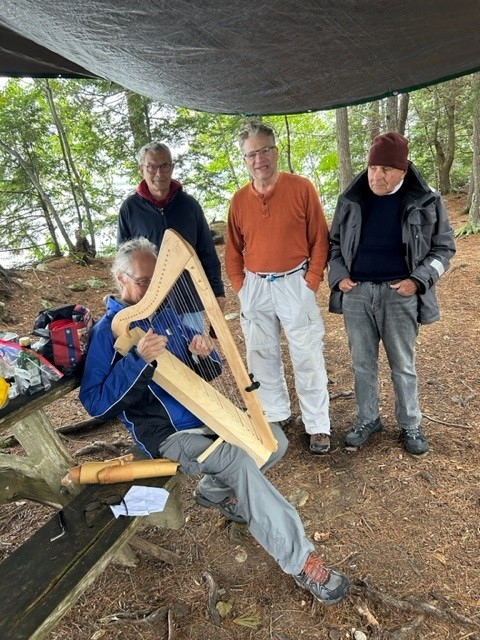
After we landed, some campers on shore, senior fellows like us, approached with friendly greetings. We chatted and learned they were from Massachusetts and, also like us, had known each other since high school. They were settled in at the campsite for an overnight, having rigged up tents spread between the trees. Underneath was cooking gear and hammocks for sleeping and, unexpectedly, a wooden harp, propped up against a small bench.

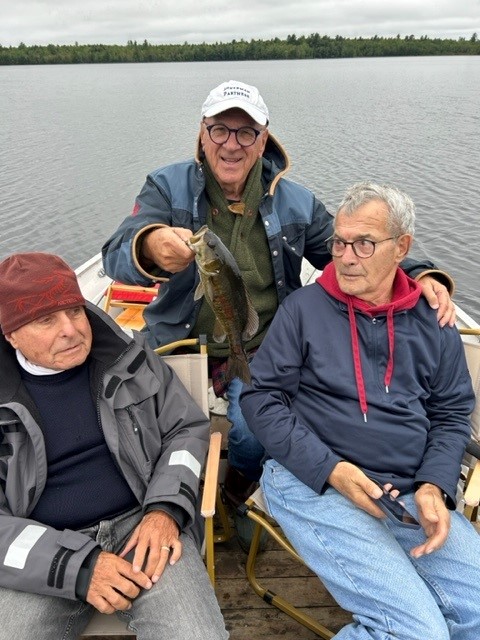
One of the campers picked up the harp and began to play for us. The gentle notes were delightful and so incongruous to the surroundings I suddenly felt transported back to a chamber music concert at Boscobel House on the Hudson. Yet here we were out in the middle of nowhere enjoying classical music with some new friends. Miraculously, the weather completely cleared up after lunch. We fished at a former dam, one of Greg’s secret fishing holes, and the guys got into a slew of fish. I caught a small mouth bass and they had their fill of sunfish, bass and carp. All in all, it was a grand day of boating, fishing, lunching and music on Lake Baskahegan.
harp-2.jpg

Fishing the Morning

Support The Mountain Messenger by purchasing Lenny Ackerman’s collection of Here Back East columns, Fishing the Morning!

Fishing the Morning Jacket

A Change of Scene

Next week is my last scheduled trip north to camp.  A planned visit with my high school friends, less one, is something I have looked forward to each year since 2020, when we all first ventured as a group to camp for a sleepaway. This year it is guys only. No plans for Wheaton fishing guides.  Only local fishing with Greg, exploring around the lake in my 1950s motorboat, steak, and lobster on the grill and plenty of catching up.  I am planning a walk to Sucker Lake and a picnic on the island.  Bob likes to fish from the dock.  Arnie enjoys the evening campfire.  Harv always serves us the best of wines.  And I just enjoy hosting my buddies.  This year our friend Jer decided to rest his back, avoiding the long drive from Wellesley, Mass.  We will miss him.

There is much to look forward to, however when I think about the usually pleasant drive north to camp from Bangor airport, I feel some trepidation.  According to the Houlton Pioneer Times, our local weekly newspaper and a reliable source, a neo-Nazi training ground is being built in Springfield, a small community a mere 30 minutes south of Danforth, my camp home.  This news is alarming.  Springfield, population 400, is known for its local Labor Day Fairgrounds.  It is a typical rural Maine town along Route 169 with a gas station, a roadside pizza stand and, aside from the fairgrounds, not much more.  Now it appears to be the setting for extremists to indoctrinate their followers in weapon use and hateful ideology.  It is a disturbing development, yet the state of Maine has no laws prohibiting paramilitary training activities—an invitation to these groups to form their camps there. According to the Houlton article, local legislators are moving to enact appropriate state laws to prohibit such activities.  As I drive through Springfield next week, I will be conscious of the extremism taking root in my neck of the woods.  Will Nazi flags become part of the scenery? Will the last 30 picturesque miles to camp be blighted by symbols of anti-Semitism?  Who would’ve thought!  Once again it was a small weekly paper, published in the heart of the wilderness, that brought important news to my attention.  Local reporting is best at sorting out the good and bad in our beautiful Maine.

Homewater

It was a bit overcast with a threat of rain when late morning Ted, Greg and I pushed off a steep embankment near Bancroft Road in Danforth.  My Grand Lake canoe had not been in the water yet this season and I was eager to cast the morning.  The wind came from the southwest and with the high water the current took us immediately downstream.  I stood up in the bow and unleashed my five-weight, nine-foot rod toward the bank.  A yellow popper drifted on the end of my tippet and a small bass took to it.  It was a fine start.  The river ran softly and the eagle that soared along with us called out its song of happiness.  No one was fishing from the bank, nor were there other floats on the water—only us in the quiet of the river.  Fishing the morning on a float was reminiscent of trips to Labrador, the Restigouche and the Miramichi, all in Canada.  This was my Homewater.  I was not a visitor or vacationer.  Greg’s hard work in finding a landing and in fact creating one, launching my canoe and directing us to the best pools for fishing made the day perfect.  I often say to friends “it is the journey not the destination.”  Here it was the destination—a place near my camp where I had peace and quiet.  We fished until we came to a bypass of sorts where the river went off and created a 20-foot-wide mini-stream.  Pushing through Greg found a spot to hold the canoe steady while I stepped out to fish a pool created by the confluence of another small stream.  The overhang from the trees gave me just enough room to backcast without sacrificing a fly.  The fish were plentiful. Ted had me using streamers as well as top-of-the-water flies.  Wet feet and all I cast away with only one thought in mind:  I could come back to my homewater any time –no reservations needed. 

Blueberry Fair

During the last week of July, there is an outdoor marketplace in Kennebunk called the Annual Blueberry and Craft Fair.  I attended this year for the first time as a “vendor” and spent a sunny Saturday on the tree-shaded lawn of the First Parish Unitarian Universalist Church, the event sponsor.  I arrived early to arrange my fold-out card table with an assortment of my watercolor paintings and copies of my new book, Fishing the Morning.  I had my kids and Patti with me, and Brooke and Billy helped set up the table display very professionally ala Peter Marino (where Brooke works as an interior decorator).  I brought my newspaper and a book in case it was slow, but the crowd grew quickly.  I had an ideal location, adjacent to the local library which was holding their annual book fair at the same time.  The shoppers coming from the library had to pass me before making their way to the tables and tented booths at the craft fair.  There was an interesting assortment of browsers: young, old, retirees, college students, children, visiting family and friends and of course all the regulars who attend year after year.  My first buyers were two youngsters who were drawn to the title of my book and immediately charged into questioning me for the best fishing locations in Kennebunk.  Well, I had to be on my toes for these kids. They wanted to know the where, the when and the how about fishing the morning in Kennebunk – a place I have never fished.  Well I took the boys aside and suggested a couple of places that I had scouted to sketch some of my paintings—an area at the entrance to the Kennebunk River with the tide coming in.  I seemed to have satisfied them such that they asked their mom to buy my book.  I explained to her that the book was a compilation of columns about a lot of things not only fishing.  The boys didn’t care—they were already scanning my fishing paintings and questioning me about each of them as to the type of fish and where I caught them.  The boys were sold and their mom had no choice but to buy my book.  I threw in a painting of a trout as a bonus.  Next were some women visiting from western New York.  One picked up my book and saw that I was from Rochester.  That was enough for them.  A book sale and a Maine painting of Cape Porpoise.  The fact that I was both the author and painter required for each sale a personal handwritten note and signature on the item sold.  Later, a youngster standing back from the numerous browsers finally asked if I had anything for $5.00.  I had been selling everything for $20.00 but said “Of course!” It was the end of the day, and I was ready to fold up my operation.  I offered her any painting left.  She carefully looked through my entire inventory—I sold more than I ever expected so there was not much left—but she found a touching piece I had painted from the deck of our house in Kennebunk of sailboats swaying in a gentle breeze at high tide.  Just as we were closing the deal, her mother and aunt came over to round the youngster up to go home.  Hearing about our transaction, the mom bought my book and the aunt a painting.  It was a trifecta of sales.  I never finished my newspaper and the book I brought never made it out of my tote.  We toasted the day by sharing a basket of organic blueberries, purchased from one of the other sellers. Thanks to Tom Veronisi from the church for running a terrific fair. 

Conversations: Harbormaster

Though I have been to Cape Porpoise many a morning, coffee cup in hand, to watch the lobster boats come in and to read the paper, I have never seen the Harbormaster on site.  Yesterday I was in luck and went down to introduce myself.  His name is Frank Orr, and he kindly agreed to spend a few moments with me, to tell me about his work. 

What are your primary responsibilities?

There are a lot of things to do, but my main responsibilities are the safety of boaters, and the safety of the waterways, as well as enforcing the boating regulations and laws, like mooring permits.

What qualifies you to do this kind of work?

 I have been on the water my whole life and got training through the Coast Guard. I was working on a crew up in Portland, just boat towing and assisting people in distress– things like that.  One day the boss came down to the wharf and asked around if anyone was looking for work with a Harbormaster.  I said I’ll do it, and he said if I want to know what it’s like go talk to this guy in Freeport, he’s looking for an assistant.  That was 17 years ago. I’ve been doing it ever since.

Are there many recreational boaters here?

We see some of the property owners and summer people, but the commercial guys still have priority. 

Are there any ferries that go out to the small Cape Porpoise Harbor Islands?

A couple of fellas here have charter fishing boats but no ferries or recreational tour boats of that kind.

Harbormaster must be a tough job in the winter

Oh yeah, it’s icy, icy. A lotta snow removal. 

How do the lobstermen and other boaters navigate out there in bad weather?

Most use GPS, and the buoys can be picked up on radar from a distance.  They have reflectors and even though it’s a little thing the size of a trashcan, it looks much bigger on radar.  

Do you worry about these guys when they go out?

Yeah, I do.  Even on a clear day there can be a problem, but we also get a lot of fog.  I was here one morning at 8:00 a.m. The fog was so dense and I’m wondering how these fellas found their way back. I looked at the weather map, it said seven miles visibility here in Cape Porpoise. I said to myself I can’t see seven miles.  But they had enough to get back.

What time do they get their start in the morning?

Daybreak usually.  The parking lot is restricted to commercial fishermen starting at 4:00 a.m. and they’re usually they’re back in by 8:00 a.m.   If it’s early in the season a lot of these guys have 8-900 traps.  They’ll go out and set a bunch then the next day they’ll sit.  The next they set more and the day after they’ll sit, then after that they start hauling in the first set and cycle through pulling in a different set until they have pulled in all their gear.

What are the economies of the lobster business these days?

Tough business.  The young guys are concerned with the new federal laws limiting their operation. The laws keep getting tighter and tighter and there’s no extra money.  The price for the lobsters is inconsistent. The fuel is always expensive, so it bait. A lot of these guys just barely pay their bills.

Is it like a fraternity of lobsterman, are they a close group?

 Yeah, they look out for each other, right? It’s kind of a unique harbor, primarily dedicated to commercial fishing. They are like a fraternity.  There is a Maine Lobsterman’s Association that supports the lobstermen and the state’s lobstering heritage.

Maine, July Trip on the Way to Camp

This year’s Maine trip to Kennebunk and camp got off to a good start despite an early rise and hitting the three ferries all before 9 a.m. The SUV was packed to the rafters with all kinds of things–my coffee supplies, snacks, clothes for various social events, my tennis racket in case, a stack of books I have been meaning to read, a full office knapsack with everything from pencil sharpener to note pads and pencils and of course my new old Smith Corona to exchange for my old 1940s Hermes at camp.  The typewriter switch was the plan, that is until the Smith Corona—a gift from my kids–fell off the tailgate and crashed while we were packing.  The space bar doesn’t work now, so it is headed to a top typewriter doctor in the area for repair.  There were a few things in the trunk of Patti’s, but I dominated the back of the car with my stuff. It was like a safari only without the Land Rover—no large animals but plenty of lobster en route. The sunny day took us halfway to Worcester, Massachusetts, where we stopped at the Miss Worcester Diner–a little metal shack with a dozen stools at the counter and five cramped booths. These petite metal diners are typical of the area–dropped off the back of a truck in the 1950s complete with a simple grill, they were all self-contained.

After a short wait in line in the parking lot, we were escorted to one of the tiny booths in this old-time breakfast establishment, open 5 a.m. to 2 p.m. daily. The air conditioning was a relief.  Run by an all-female waitress and cooking staff, family-like, everything was timed to the minute:  coffee, take your order and then wait.  It was a pleasant atmosphere, with colorful stickers all over the walls and ceiling and tacked-up, hand-made advertisements selling everything from mugs to t-shirts with the diner logo. This was our second Worcester diner experience. A couple of years ago we found the Boulevard diner almost by accident. We needed a quick tail pipe repair (my backing up error at a gas fill up) and were directed there to wait. I have been dreaming of going back to a Worcester diner ever since. Anyway, back to the food–the best pancakes I have ever had including the Highland Park Diner growing up in Rochester. A veggie omelet I could not finish. I rolled out of there for the next leg of the ride to Kennebunk but what I really wanted was a nap.  It was going on 1:30 p.m. and we had another two hours of I-95 to travel. The nap would have to wait.  I felt good though.

             Seems I was destined to have some interesting dining experiences on this trip north. A few days later, dinner at Little Barn in Kennebunk, Maine, with Florida friends was memorable: President George Bush and his entourage showed up, Secret Service detail and all.  When they walked in there was a momentary hush in the room.  Then he started talking to people he recognized; his Texas accent stood out above the restaurant din. No autographs or photos taken–seemed most of the restaurant guests knew him or were related to him—a lot of high fives at the tables around us.  We were the outsiders. The former President was jovial and seemed happy.  His family compound is down the road in Kennebunkport at Walker Point.  Never know who you are going to run into passing through Maine.

The Trail – Again

Last week at camp I ventured out onto the Wheaton Trust trail off Route 1.  It is the same trail where I lost my way back in 2018, sweating through the wilderness to find myself only 500 feet from the highway, but some miles from my initial point of entry.  This time I was accompanied by my kids and had the benefit of the new trail map brochure prepared by the Trust.  The brochure is now available locally and at the trail sign-in post.  The route is well marked and provided one pays attention to the map and the trail markings, getting lost is not an issue, though none of that is any use without the stamina and balance to handle the two or so miles of natural terrain to Sucker Lake.

The trail begins rather seductively some 1000 feet from the turn-off, with a cleared walkway to a car-width sized opening, everything plainly marked, and open to the skies.  A few feet away a wooden bench is chained to a tree – undoubtedly a welcome sight to exhausted, returning hikers and perhaps a bit of a hint to what lies ahead.  Eager to be on my way, I darted into the thick woods, my daughter Kara and her husband behind me.  The trail quickly narrowed to the width of a bleacher row at Yankee Stadium – little over a foot wide.  The ground was uneven with roots bared and tree stumps and sawn branches from a recent cutting.  The light was much dimmer.  There was no reason for sunglasses so I tucked them into my shirt pocket and slowly adjusted to the reduced light in the heavily canopied wood. I noticed how quiet it was.  There were no morning birds or sounds of water lapping against the rocks– just stillness.  We were alert at every turn for the next small directional sign nailed to a tree and the occasional painted limb indicating a trail marker.  It was easy to miss these clues when forest debris or mud puddles obscure the obvious pathway.   The trails are not level and obstacles, such as a fallen tree blocking the path, can be disorienting– like taking a wrong turn an unfamiliar city.  Without clear detour signs one quickly loses direction.  I always keep my head down to avoid a stumble, however with eyes on the ground it is easy to miss the trail markers.  I learned my lesson the last time.  These trails are marked early in the season and nature has a way of not adhering to anyone’s schedule.  Avoiding the mud puddles from the recent rains then returning to the prescribed marked area on the map took a bit of walking back and forth to reorient ourselves.

The hike from the trailhead to the picnic area at Sucker Lake took us an hour and a half—a distance of only two miles.  The over, the under, the balancing, the crossing of small streams, the muddy, low-lying areas and the large granite boulders all made for a bumpy trek.  This time, with the help of my ever-alert children, the well-marked trail, and the new map, we did not get lost and together conquered a great hike.  I sent my kids back to camp through a shortcut in the woods from the lake and I ventured on to pick up the truck from the trailhead.  My cell gps calculated another hour walk so I decided it was enough.  I turned around and took the same familiar shortcut back and hitched a ride with Katie to my truck. It was enough hiking for one day and I most certainly did not want to push my luck. 

Fishing Lessons

The weather in Maine was an unseasonable 82 degrees when Patti and I landed in Bangor. Usually, on the first week up north, I’m greeted by 40-degree weather, overcast skies, black flies and a broken water heater at camp. The drive along I-95 was uneventful, with just a quick stop at Governors for chowder and a piece of unfried fish.  One more stop at DQ for a soft ice cream and we were on our way to Lincoln to go food shopping for the few days we had planned to relax by ourselves, and I could do a little fishing.  By the time we arrived at camp, it was nightfall.  After a quick toe dip at the end of the dock I headed straight to bed and slept. Next morning I woke up with the sun at 5:30a.m. and took my coffee to the dock.  The fishermen were all out on the water, trolling for salmon and lake trout. The warm weather brought out the weekday anglers.  I needed to catch up on a few office matters before Greg, my local fishing guide, and I could take off on another of his expeditions to a “special place” where the trout are “18 inches.”  He came by promptly at 1:00 p.m., ready for an afternoon of catching.  He was as usual enthusiastic and promising a bit more than he can usually deliver –but it is not his fault, the fishing rods are to blame. “Bring rubber boots,” he said as I was getting into the truck.  But I was already prepared with them—a brand new pair I had just purchased from an online outfitter. Off through Danforth we flew, on the main roads and then the backroads, with a brief stop at his buddy’s house to hitch up an old rowboat with a 15 hp motor.  Greg and his friend grew up together and both work in the woods, for the lumber industry.  This fellow never married until recently, when he fell in love with a widow and now, according to Greg, he “never leaves the house.” We arrived at a small bridge over the Mattagodus Stream.  Anxious to get a fly in the water, I took a few casts from the shore as Greg maneuvered the boat down an embankment.  With a splash, it was ready to go.  We traveled upstream, winding our way through a 20-foot-wide expanse of water that was the confluence of several smaller streams passing through miles of wetlands on both sides.  There were no other fishermen in sight.  When we got to a promising spot, Greg turned off the motor and we both cast–Greg with his live bait on his spinning rod and I with my flyrod with a dry fly.  The sun beat down on us mercilessly.  The wind was minimal and the only relief was when Greg sped upstream.  We reached a bend and Greg promised (again) some action at a nearby beaver dam.  He beached the boat and I waded ashore (reason for boots).  The ground was marshy with areas of soft mud.  I walked further upstream away from Greg to the beaver dam and started casting.  With my rod in hand, I carefully moved closer to the water to avoid a back-cast hookup.  Suddenly I had a fish take and now had to move away from the water to better maneuver bringing in the fish.  But the wetlands were muddier and wetter as I moved back from the stream.  Suddenly, with a fish on the line, I felt myself sinking slowly into the mud.  Greg was on the other side of the bend in the stream and out of sight.  He was too far to hear me if I called out.  I gripped the rod as I continued to sink even deeper.  The mud was now over my boot top.  I had to make a fateful decision – the fish or me!  I chose the fish.  So as sank, I continued to play the little fishy, drawing him in. There was no sense of panic about getting myself out of this, but it would be messy.   I laid down on my stomach, still holding my rod with the fish attached, and slipped out of my boots. I reeled in my catch and walked, barefoot and covered in mud, back to where Greg was fishing contentedly. “What happened to you?” he said, eyeing me from head to toe. “I caught a fish, that’s all!” I answered, holding up my prize. Was it 18 inches? Not even close. And I lost my new boots for it. Yet I was happy. Actually, it was refreshing to take a mud bath on a day with temps in the 80s.  I guess I had been a bit scared there for a minute, but I knew it wasn’t quicksand, just wetlands.  And there is always an upside to things. I learned not to back up into wetlands, always carry a whistle, and wear slip-off boots when fishing.

Standing in Line

Lenny Ackerman

Before we left Kennebunk for camp I promised Patti I would get up early on Saturday and be first in line at the Boulangerie bakery in the village.  Good to my word I was at Provisions market for my newspapers and first coffee at 6:30am and hurried over for the bakery’s opening at 7:00 am. Little did I know that a dozen or more people had the same idea.  Not too bad I guess since I had my New York Times and could read in line.  It would be the last newspaper I would dirty my hands with for a week, since there is no delivery up at camp and the nearest stand is 45 minutes away. The line of people extended into the parking lot and I joined the queue behind a young, friendly-looking couple.  Of course, I struck up a conversation instead of reading the news of the day.  I caught the woman’s eye and asked, “Are you local?”

“Yup” she said.

“Kennebunk?” I asked.

“No, Wells.”  Wells is an adjoining community down Route 1 south.  Her companion was not participating in our chat at all – not caffeinated enough to talk I guess. I was deep into my large coffee and continued:

“Is it always this busy before they open?” I asked.

“Yup,” she said. 

As you can tell I was not making much headway with my small talk, so I upped the cross-examination: “What do you both do in Wells?”

“My husband,” she said, looking up at him, “is a psychologist.” 

Oh well now I knew why he wasn’t answering me.  He didn’t want to have to offer any free advice.  Now that the husband was exposed, he had no choice but to enter the conversation.  He turned toward me.  “What do you do?” he asked, looking me in the eye. 

“I am visiting here,” I said, “but I practice law in East Hampton, New York.”  

That got him interested. 

“You mean the Hamptons that I read about where all the rich people from New York go for the summer?”

“Yes,” I responded.

“And what area do you specialize in?” he asked.

“Land use,” I said. 

He shook his head.  “That’s a waste of time—soon there will be no land to use at the rate the ocean in rising.” 

Well now we were talking.  I explained there is very little land to use in the Hamptons already, rising oceans notwithstanding.  He wanted to know more, so I talked about how the town was late to preserving open space in the 1980s.  By the time they adopted a zoning code, most of the waterfront including the ocean, bay and pond frontage had by then been built upon.  The release valve is variances–my line of work.  The process is a log jam of administrative review, as the climate is very anti-development now.  The majority of the applications are to rebuild on demoed property.  He told me Maine started conservation of wetlands and open space many years before development and because the demand was less than on eastern Long Island, Maine was able to preserve much of its environmentally sensitive open space. 

By the time we discussed the current state of land use and preservation in both states we were at the front of the bakery line.  I left with a loaf of sourdough and some croissants – and that good feeling that comes with having an engaging, impromptu conversation with a stranger.  

Camp with the Kids

Lenny Ackerman

My adult children and grandson were waiting for me curbside at Bangor Airport.  They had all arranged to gather at LaGuardia to fly up together for their exclusive week with Dad at camp. My son-in-law Peter was on his cell catching up with business as my daughters waved me over.  After quick hugs and hellos, everyone piled in the Bronco, anxious to get to camp–but not before our planned stop for lunch at Governors, a family restaurant which is part of a chain exclusive to Maine. 

                A family week together at camp has become an annual event for the past several years. When we are all under one roof again it is immediately like old times, though we have had our separate homes for years now.  Shared meals and campfire stories of times past and plans for times to come reconnect us and deepen bonds. 

                I planned to take everyone to Sucker Lake for fishing and a cookout.  Kara and Peter opted out for yoga and conference calls.  Brooke and Billy drove with me in the Bronco over the snowmobile path to the entrance of the lake area.  A bumpy ride but the Bronco handled it as advertised.  Greg met us there with a portable battery-operated motor for the rowboat moored at the shore.  The motor was silent so the quiet of the lake was maintained as we traveled the short distance to a small island for a barbeque.  Greg started his campfire while I waded into the water for a few casts.  Billy tried his hand at wading and casting alongside me and I noticed he was more confident in his technique this year.

                Lunch was a typical Lenny picnic menu:  hamburgers with mustard and relish.  The appetizers and dessert were catching a bass, so after a few bites I rushed everyone into the rowboat to find a spot where the fish were waiting for us. 

                We maneuvered over to promising-looking cove and before long Brooke and Billy caught several mid-size fish.  Dad landed a few but the exercise was to have the kids experience the lake and its surroundings.  There were no camps along the lake shore, no signs of anyone else.  Just pure wilderness.  Truly a heavenly place.