Music at Baskahegan Lake

It was a rainy, gloomy morning at camp. We had all arrived at different times the night before. My trip from New York to Maine by air was the most direct. Harv came by bus via Albany and Arnie and Bob drove 700 plus miles from western New York. Our first day at camp looked downright crappy. All our pent-up expectations of fishing and hiking during our short stay were weighed down under a cloud of dense fog.

Being the optimist that I am, I went ahead and organized, with Greg’s help, a cookout at Baskahegan Lake — and some fishing if the weather permitted. I could not let those Harry Hots, Don and Bob’s Hot Sauce and Genessee beer–all our teenage favorites transported direct from Rochester in the back of the car on that 700-mile ride–go to waste. With intermittent rain predicted throughout the day, we bundled up for wet conditions and headed off late morning. We followed in the Bronco as Greg led the way, trailering his boat loaded down with cooking supplies, fishing gear and of course our luncheon special.

The boat launch at Baskahegan is nonexistent – one wades into the water to embark. Wet in the feet already, I felt a mix of regret and foreboding that I had talked everyone into spending the day on the water. Greg had a campsite in mind for lunch and found his way across the broad reaches of the lake without GPS or a compass. As we approached the shore in a light fog, a couple of kayaks appeared—one a traditional yellow fiberglass and the other an unusual handmade one of varnished wood—and they just as quickly disappeared.

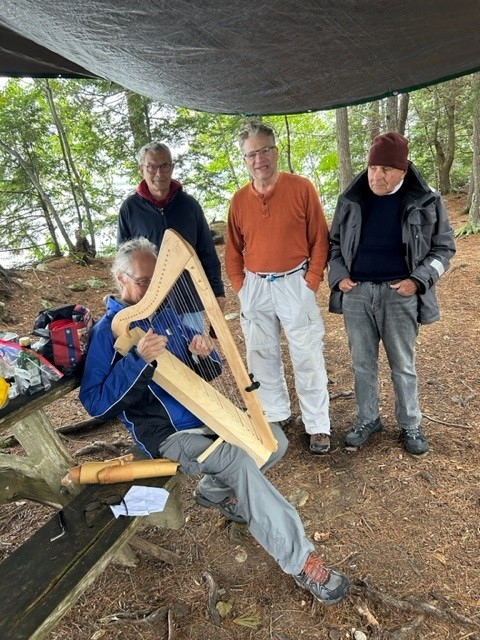
After we landed, some campers on shore, senior fellows like us, approached with friendly greetings. We chatted and learned they were from Massachusetts and, also like us, had known each other since high school. They were settled in at the campsite for an overnight, having rigged up tents spread between the trees. Underneath was cooking gear and hammocks for sleeping and, unexpectedly, a wooden harp, propped up against a small bench.

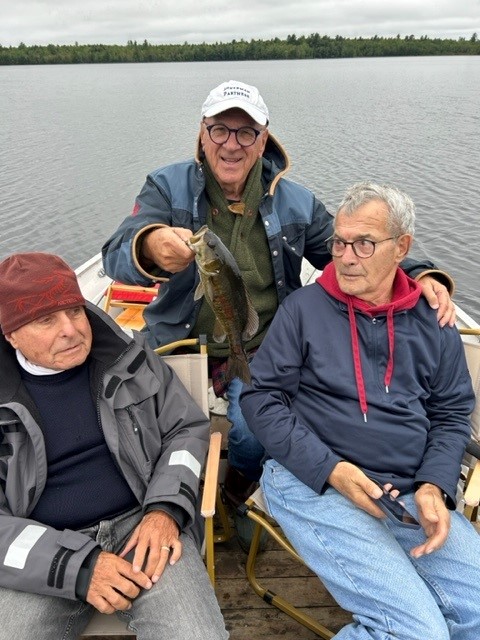
One of the campers picked up the harp and began to play for us. The gentle notes were delightful and so incongruous to the surroundings I suddenly felt transported back to a chamber music concert at Boscobel House on the Hudson. Yet here we were out in the middle of nowhere enjoying classical music with some new friends. Miraculously, the weather completely cleared up after lunch. We fished at a former dam, one of Greg’s secret fishing holes, and the guys got into a slew of fish. I caught a small mouth bass and they had their fill of sunfish, bass and carp. All in all, it was a grand day of boating, fishing, lunching and music on Lake Baskahegan.
harp-2.jpg

Fishing the Morning

Support The Mountain Messenger by purchasing Lenny Ackerman’s collection of Here Back East columns, Fishing the Morning!

Fishing the Morning Jacket

Teachers

Last week my friend from Rochester, Arnie, forwarded the obituary of Pincus Cohen, one of the last surviving teachers from our Ben Franklin High School days back in the late 1950s.  Mr. Cohen taught Spanish during our time there and subsequently went on to become high school principal.  I did not have Mr. Pincus as a teacher since I took German as a second language, naively believing that the Yiddish spoken at home would help me with the course. The notice of Mr. Pincus’s death led to a feature article in the Rochester Democrat and Chronicle reminding readers of the time when, as principal, Mr. Pincus took out an ad in the paper to recognize the students who made the honor roll.  He said there was always press coverage when someone does something wrong, so it was time to acknowledge those young people who work quietly and diligently doing something right.  He paid for the ad himself.  The $100 expenditure sparked a flurry of national interest and brought brief fame to my alma mater. 

In subsequent years the school as we knew it closed, reopening as a cooperative vocational institute.  No longer was it the hotbed of youth from diverse backgrounds –Black, Italian, Jewish and many others—that I remembered from my teenage years.  Extracurriculars were sports, journalism and music and graduates attended Harvard, Yale, Penn and various state schools throughout the region.  Several of my class became doctors and lawyers.  Some obtained PhDs and went on to careers in academia.

We never gave enough credit to the teachers who guided us.  Like Mr. Pincus there were several standouts.  Homeroom teacher Mr. McCormick introduced me to the New York Times which I still read dutifully every day.  There were sports coaches who went above and beyond for the athletes among us. For those of us who did not have help from parents with limited education, teachers were the surrogates to whom we went for advice, particularly when it came to the most important decision of our young lives: what to do after high school graduation.  Ray Iman was a history teacher who wore Brooks Brothers suits to class every day and took several of us under his wing, mentoring us through the college selection and application process.  He sat a few of us down in the front row of desks in the classroom after everyone else had run out and described for us what life had to offer if we worked hard, played fairly and stayed out of trouble.  But it wasn’t the same for everyone.  I remember the story of a sophomore girl in my homeroom who had stopped coming to class. The rumor was that she was pregnant.  Back then, being an unwed mother was a scandal and unacceptable in society.  Her boyfriend, presumably the father, experienced no consequences.  As I recall, she was an outstanding student.  Mr. McCormick gave us a short lecture about choices and without mentioning her name talked about how making a wrong turn can change your life forever.  That talk stayed with me. There are lost opportunities and opportunities lost.  Teachers made the difference for many of us. In hindsight, things might have been different for her if she had been mentored, the way the boys were.  But girls were steered toward marriage and motherhood. She never returned to school.

Moose Lodge at Palm Beach Gardens

I walked into the Moose Lodge on RCA Boulevard feeling out of sorts.  The scheduled Celebration of Life for Nanci was due to end in 20 minutes. Otherwise, it had been a usual Sunday for me, with a busy morning—a Garden Tour in Palm Beach with Patti and then lunch with Caroline and Sam.  After dropping off Patti at her place I sped north on I-95.  I pulled into the parking lot mostly filled with pick-up trucks and a few motorcycles.  Outside were gathered a few smokers with beer bottles hanging loosely at their sides. The glances my way made me feel a bit uneasy.  I walked through the entrance into a reception area with pictures of past Moose members.  I then realized I didn’t really know why I was there.  Nanci was one of the regular counter gals at Greens, my local pharmacy and lunch place in Palm Beach.  Over the past 20 years I only knew her first name and that was from the nametag she wore.  Not one to talk much she was always short on words and did her job—take her order and return to gossip with the other counter ladies.  I was never successful in engaging her in a conversation.  In fact, I was cautious not to call out my order to her until she was ready and standing at my table with her pen out and a note pad in hand.  In hindsight I thought that perhaps by coming to her Celebration I might learn a bit more about her.  She always seemed a bit out of place at the counter.  She was tall and evidently had once been a “looker.”  Who was Nanci and did I miss something or offend her in some way over the years? I never observed her in real conversation with any customer though, so maybe it wasn’t me.  She was there to do her job and she did it well.  Nanci would not know I was there to pay my respects, but I wanted the other counter ladies to know I do care.  That was the point, I guess.  I roamed the room, furnished with round tables decorated with printed logos of the Washington Redskins -now called the Commanders.  Large photos affixed to the walls showed Nanci in various stages of her life: motherhood, partying in Key West, in a Redskins football jersey, and having fun with her many friends.  The music played, country and western.  The open bar had a line.  There were homemade cookies and brownies.  This was not an “eating” party.  The beer and desserts must have been what Nanci would want.  Someone had made a video of her life over the years and a few of us stood there watching it.  The counter women from Greens sat around a table and I went over to say hello.  I believe I was the only customer who showed during the Celebration.  I felt a bit awkward speaking to them.  I sensed they were looking at me and wondering “what is he doing here?”  I walked around the room once more and saw a table with condolence cards made out to Nanci’s family.  I thought perhaps I should have brought one.  I looked for a guestbook to sign, but then I don’t think anyone really cared that I was there.  I left as I came in, wondering why I had gone in the first place.  I guess sometimes we do things for a reason that only make sense some time after the event.  This was one of them.  I am glad I went.  I cared for Nanci. 

Overheard: The Gift of Yourself

At a recent dinner party, I overheard our hostess Chris share an incredible but true story at her end of the table.  As she related it, three close, older men–retirees who regularly played golf together in Florida–were gathered at a memorial service for their recently deceased fourth golfing partner. During the event, they were informed by their late friend’s daughter that her father had made a special provision in his will for them: the three  buddies were to enjoy a long-planned “bucket list” golfing tour of Scotland at his expense.  He left them $100,000 to ensure a leisurely trip of a lifetime,  playing all the top courses while staying at the finest hotels and luxury accommodations. 

The three friends embarked on their appointed trip, and everything went according to plan.  They had a spectacular time and were near the end of a month-long trek through Scotland, when they found themselves having dinner at a pub near St. Andrews.  Seated at a nearby table was a young family of four speaking a foreign language amongst themselves.  They were focused on one of the children, a boy of about 11, who was translating the menu for them in heavily accented English.  At one point the golfers exchanged hellos with the family and initiated a conversation with the English-speaking child, who explained that he learned English in school and his family were refugees from the war in Ukraine.  They had only been in Scotland for a few weeks.  He described the family’s desperate plight, trying to find a permanent home and future in Scotland. 

              The golfers returned to their meals and quietly contemplated what they had heard.  Before leaving the restaurant, they made a decision:  since they hadn’t spent all of the money set aside for the trip, why not share the remainder with this family in need?  How much was left?  $40,000 – a life-changing amount.  What was one more round of golf and another fancy hotel when it was so clear what they should do.  So after a toast to their departed friend, it was done.  I can only imagine that there was more than a monetary gift.  I am certain these Florida golfers with years of experience in life’s ups and downs also offered invaluable advice to this stateless family about starting over in a new land.

Everyone at our dinner table had tuned in to this remarkable story.   Afterward, there was some spirited conversation about various methods for giving to those in need, not just money but also personal advice.   Subsequently my friend Bill and I had a talk about giving, both monetarily to those less fortunate as well as giving advice to friends and loved ones.  We are both professional “advice givers” – I am an attorney, and he is a financial advisor—and both of us often work “pro bono.” I refer to this concept as the “gift of yourself.”  If you have the extra money, it is easy to donate it. There is more effort in allocating the energy and time to advise, which requires one to stop, listen, and consider another person’s feelings, issues or desperation– and act in response.  Too often I hear “I have no time” or “that is not my problem” as a reaction to someone in need of some basic human empathy. The Florida golfers received a gift and paid it forward when they didn’t have to.  By reaching out they also gave of themselves. How many would have done the same?  As with the homeless it is easier to walk around than to offer a hand.

Out of the Mouths of Children

Much has been written of adult friendships and maintaining relationships.  Recently, the New York Times ran an article extolling the benefits of friendship as a way to improve quality of life physically and mentally.  It is a timely topic these days.  Mental health issues may be more easily dealt with when there is a friend to talk to and commiserate with when feeling low.  I find it encouraging that my grandson Billy confided to his mother about his own feelings of loneliness while he was at sleepaway camp last summer (Billy has okayed my sharing his experience):

“Sleepaway camp was my darkest days.  I never felt so alone,” he confessed.  “I had no friends.  It was there I decided that I would never feel that way again.” 

Billy was homesick and it was his first year at a camp.  The other campers had long-established connections going back many summers and it was hard to break into the group.   Billy has matured over the last year to a point to where he now feels free and comfortable enough to express his feelings.  I was proud of him.  I had encouraged him to go to camp.  His father, who did not have a good experience at sleepaway when he was young, assured him he could leave if he didn’t like it, but Billy stuck it out.  Billy was starting a new school in the fall and knew he did not want a repeat of his camp experience.  He went out of his way and made a real effort to connect with the kids in his class.  Today, at his new school, Billy has a bunch of new buddies, and his social life is almost as busy as his grandpa’s. 

Billy related his experience in a recent Uber ride:  

“I was driving up Park Avenue with my new best friend the other day and I looked out the car window and I said to myself, I did it. I’ve got a best friend, and everyone accepts me.   My friends are cool and this was my goal. My Bar Mitzvah will be the best party ever.” 

The New York Times article relates how keeping friends is not effortless.  Billy concurs: 

“You know it takes hard work to make friends.  Finding real friends is not easy.  Me and all my friends—all we do is laugh and do silly stuff.” 

That’s my Billy-boy.  I am looking forward to having Billy and his companions up at camp on the lake being silly.

At the Counter

At Greens, my go-to lunch counter after exercise, I overheard the guy at the next counter seat ordering for himself and his “best friend.” Green’s is a homey, old-fashioned pharmacy that has been serving the north end of Palm Beach since 1942.  The waitresses at the breakfast-lunch counter know many of the patrons by name, most of whom are year-round locals.  The fire rescue gang are always there – a good place to be if you need emergency help.  The local Palm Beach police are also regulars– not an ideal place to be disruptive, or a criminal.  All in all, it is a warm, nostalgic environment, just down the road from the famous Mar-a-Lago.  Back to my neighbor at the counter.

“Grilled cheese and tomato,” he said to the waitress.

“And for your best friend?” she responded.

“Oh a hamburger will do,” he said.

“Lettuce and tomato with french fries?” she asked.

“No I can’t give my buddy that stuff,” he said.

“Your friend ill?’ she asked.

“Nope, he isn’t a person, he’s a dog,” he answered. “He is my only friend,” he said laughing. 

Well, why not.  Friends come in all shapes and sizes – humans and pets.  I have best friends going back to my grammar and high school years as well as college and beyond –not to mention several four-legged “best” friends throughout my life.  My friends from Rochester, probably my oldest friendships from childhood, have a connection through our shared history together, of our families, early education, careers, heartbreaks and love lives. My good friend Bobby recently told me: “Lenny, I like you more as an adult than I did as a little guy!” Now that’s love if I didn’t know better.  

I find there are always opportunities to meet new people who eventually become regular acquaintances, friends, maybe best friends. I make an effort because I believe those connections are tantamount to a happy life, and science is showing that they can even lead to a longer life. 

Friendship means opening up, to admit someone new into one’s world. In the long run it is always worth the risk.  I cherish the shared experiences with friends – outdoors, fishing and camping, dining, traveling, talking about books and business and the state of the world.  Friendship also requires forgiveness–overlooking the immature remark or even the breach of trust. 

I consider this column an important part of maintaining my friendships because it is a way of staying in touch.  Friends who read it often respond with some kind of feedback and depending on what I’ve written about, share similar experiences of their own. I am often delighted to learn new things about old friends through this column.

I feel fortunate to have as many friends as I do.  On Thanksgiving, I received notes and emails from all over —Tennessee, Colorado, California, Wales and Iceland.  I embrace my friends, literally and figuratively – I am one of those huggers.  I am grateful for all those who I call and who would call me friend—including the latest four-legged one, Patti’s dog Wally.  

A Conversation with Sam White

April 2022

A lifelong career in land use law has afforded me opportunities over the years to learn, explore and even profess some knowledge of local historical architecture. Recently I appeared before the local zoning board to see the restoration of a magnificent home designed by Albro & Undeberg circa 1914 in East Hampton Village. Advocating on behalf of the owners of beautiful, architecturally significant properties allows me the additional benefit of associating with the people who specialize in their restoration. In the course of my work on a new project, a home built in 1926 by Roger Bullard, designer of the renowned Maidstone Club, I made the acquaintance of Sam White, a great grandson of Stanford White. Stanford White was a partner in the firm of McKim, Mead & White and was arguably the most famous architect of his day, during America’s Gilded Age. His legacy survives in the many buildings he designed and built including the spectacular “Seven Sisters” shingle-style houses on the cliffs of Montauk at the easternmost tip of Long Island.


In my meeting with Sam, I asked what it meant to him, as the descendant of such a famous architect, how it had impacted him personally. His response: “It is a privilege that I did not earn” –a modest response from an unassuming man who has staked out an impressive career of his own in architecture. In addition, he has written, together with his wife, some four books on Stanford White and lectured extensively about his great grandfather and his legacy. Sam explained that he wrote the books to clarify a misunderstanding about his great grandfather. “Too much attention was directed at how he died and not his work.” The circumstances surrounding Stanford White’s death were sensationalized in the press and at the time overshadowed his professional accomplishments. The impact of what he did achieve was felt through the generations, as Sam’s grandfather, Larry White, had thirty-five grandchildren, five of whom became noted architects and one a landscape architect. Sam himself is one of eleven siblings.


My conversation with Sam was via zoom rather than a preferred sit down with him in the original Stanford White home in St. James on Long Island, New York–still owned and inhabited by descendants of White. After Harvard and Vietnam, Sam attended architectural school at Penn. He sought to carve out his own destiny in architecture and embarked on a career restoring historical homes on Long Island. Sam reflected on the state of architecture today. “No one except for perhaps Peter Marino is equal to Stanford White’s capacity with color and texture in his design.” A worthy compliment to a contemporary architect and designer.


It was a wonderful conversation about an architect of generations ago who lives on today in the many homes and commercial buildings he designed in New York, Newport, Montauk and Southampton. A pleasure to meet you, Sam.

Some Lessons of Covid

February 2022

The lessons of Covid are many, and the sheer numbers are staggering- of lives lost, long-term health compromised, jobs disappeared, economies ruined. It all paints a tragic picture of our age. On a smaller scale, the effects of life under Covid are more personal, yet just as powerful. My interest is in the individual. How has Covid affected those close to me, both in terms of behavioral changes and mental health-often the same thing? The answers I get vary as much as the people of whom I ask the question, though there are underlying similarities. The common theme seems to be the reduced level of human interaction and the losses associated with that.


My recent conversations on the subject with friends have been revealing. There is talk about the emotional strain of coming out of the pandemic only to be faced with the prospect of new variants, preventing any chance of a return to “normal.” The issues run deeper than having to forego a long­anticipated trip, or planning celebrations with family members. Especially now that some of the travel restrictions have eased, people are getting around more. But there is a general uneasiness and the habits of quarantine and living under the threat of a new variant linger. One of my friends said she has watched more television in the last two years than in the rest of her 70 years combined. She expressed regret that she wasn’t spending more time reading or painting or perhaps cleaning out old closets-­something more active and productive. Motivation is sapped away by the endless protocols that have also protected us. Social lives have been scaled back, friendships sustained by video conference or phones, or not at all. loneliness may be a pandemic on its own.


Last month I visited some of my oldest friends, a couple who live in New York City. The husband, a retired physician, is less active due to health issues than he was pre-pandemic but his wife of 50 plus years lamented about the lack of socializing. Her indoor tennis and card games were cancelled. Though she knows things have opened up a bit, she now spends more time cooking and cleaning, out of habit. People have gotten out of the routine of socializing. Face to face contact with friends and family has been curtailed and is only slowly making a comeback. While in the city, I noticed the restaurants were packed despite the close seating and the wet, chilly weather. Many restaurants have the enclosed, individual outdoor seating, constructed of plywood and decorated with artificial plants. There were mostly young people out and about, presumably all vaccinated–a New York requirement for indoor dining. I was pleased to be able to do my usual New York City routine: a haircut and shave at my barbershop on Lexington (everyone masked), followed by a stop at Hunter College bookstore for a slow circuit around the stacks (again, everyone masked). I vowed to keep up my old New York City routine as long as I can.

While in Manhattan, I had the opportunity to sit down with my 11-year-old grandson, Billy, to ask him about his thoughts, observations, reactions -and those of his friends-to the changes brought about by Covid over the last couple of years. “It is so, so different, Grandpa, learning at school instead of zoom class at home,” he said. “School is normal!” During quarantine, he continually complained about the lack of socializing and he spent a lot more time on his phone. Fortunately, his school recently reopened-with protocols in place-providing convenient cover for meetups with friends during lunch break and between classes. Playdates are happening more frequently now, except of course when a family member tests positive. Though he and his friends miss the socializing during school shutdowns, he admitted that, “When school is closed, we can sleep in later,” pointing out one of the few positives. As attractive as it might seem to sleep late every morning, Billy said he would gladly get up early to go to school and be with his friends, rather than hanging out in bed the extra hour. Traveling to and from school on the bus is also an opportunity for socializing. Billy attends a private school on the West Side so he “commutes” from his home on the East Side. He uses the time to catch up with his friends and plan activities. Schoof bus time was sorely missed by him during quarantine. Many of Billy’s friends from last year’s public school are being home schooled since the parents found the school system’s response to Covid so chaotic and disorganized. Private schools were open sooner and their closures have been more limited. It will be some time before we understand the long-term effects, if any, of the Covid disruptions on children, but my talk with Billy was a hopeful one, and a reminder of the resilience of youth.


Life during quarantine is a good time to reflect on family values and relationships. Confined to a limited space for months at a time, the closeness eventually reveals who we are as a family and what we really think of each other. But what about all those missed dinners and matches and classes and
coffees with friends? What about the lost jobs? A recent article in the New York Times called upon readers to leave any regret behind for the missed opportunities caused by Covid. On the other hand, the book The Myth of Closure by Pauline Boss, explores the idea of “social bereavement” and how with certain losses, closure is unattainable. We grieve as a community over the changes wrought by the pandemic. Sometimes, the loss never ceases. Loss is never perfect. We all experience the phenomenon differently. For me, I deal with the issues of loss and closure by looking beyond and anticipating impact. We rely on science for the facts, and we look to our family and friends for support and understanding, so I stay in touch whichever way I can. Even a zoom call with a friend can make all the difference.

Anniversary

January 2022

It was nearly two years ago that Carl Butz and I first had a conversation about his acquisition of The Mountain Messenger newspaper.  I had called him mainly to offer my congratulations, as he had just rescued the paper from closure and in doing so made national news, which is how it came to my attention.  We quickly hit it off, and it was that phone call that led not only to a weekly column for me, but to an unexpected and rewarding cross-country friendship.  

During that initial call, I told Carl about my late wife, who passed away in 2017, and how I had continued writing letters to her as a way to deal with my grief.  I learned Carl, too, lost his wife in 2017.  A phone call about a newspaper became something more, as we bonded over our mutual loss and loneliness.  He suggested channeling the letter writing into a weekly column.   The idea was to put down in 250 words or less, my impressions of life from where I was living at various times of year–Maine and East Hampton in the summer, Palm Beach and New York City in the winter. So, under the heading “Here Back East,” my first contribution to the Mountain Messenger, “Open Remotely,” was published on May 7th, 2020. 

Two years and 65 columns later, I look back on what has happened during that span of time, to me personally and in the wider world.  I tried to put so much of it into words on a page as I experienced it –maybe I was being ambitious, but it was always from the heart.  There have been concerns expressed, from friends and colleagues who thought that I might say too much in these columns, that it might harm my business—I am an attorney and discretion is paramount.  But my political columns were few—about the January 6th insurrection and the Inauguration Day reading by the poet Amanda Gorman.  Most of the topics are purposeful and personal — what I think about events at the time and how they affect me, my family and friends. And I write a lot about fishing—writing about it is the next best thing to doing it.  

There is no denying we live in difficult times–the never-ending pandemic, inflation, wildfires.  So much of it leaves us unsure about what is ahead.  Yet we must look to the future and not without hope. The pandemic will become endemic, like a seasonal flu.  Interest rate hikes will quash the inflationary bubble.  Technology and proper forest management will quell the flames out west.  With a positive view and an appetite for understanding and love we will get through it. We are not the first generation to think we are living through the worst, and we won’t be the last. 

I will be visiting the Sierras this summer to fish, as I will fish East Grand Lake in Maine.   My new partner in life, my sweetheart Patti, will join me.  There is much to look forward to and to write about.  My best to Carl and my friends in Downieville. See you soon.  

Fishing with Jay

January 2022

After our inaugural fishing expedition to Beaver Kill in 1990, Jay and I embarked on a fishing romance spanning 24 years until our trip to Iceland in 2014.  I returned to Iceland again in 2017 but that time as a loner.  Jay was not fit to travel after a bout of illness and I, suffering from a back injury, plowed through the trip with a distressing inflamed something or other.  Leading up to that last trip alone, was a wonderful series of travels with Jay and a few other friends, some now gone.  Our first real expedition together was deep sea fishing in Gardiner’s Bay off of East Hampton, with Captain Paul Dixon, on the hunt for bluefish and stripers.  Eventually, Jay surpassed me in his collecting of flies and gear as he had a number of friends and work colleagues in the dental profession who regularly went to the Catskills to fish on the Delaware.  Jay, being a surgeon, was into the technical intricacies of fishing.  I was more interested in finding sources for English country fishing attire, and of course I was into the travel. 

Our next outing together was trout fishing on the Connetquot River on Long Island.  More like fishing in a bathtub, with assigned beats where fish waited for meals.  The fish dined on a schedule, and as long as you were on their timetable you caught plenty.  Like shooting in a barrel.  After that, we were ready to explore beyond the shores of Long Island.  Thus began our European adventures and over the years we went to Scotland and Ireland, and to Iceland twice.  We often took local trips in between–during economic recessions and off times in the real estate practice, Jay and I would do the three-hour drive to Al Caucci’s fishing establishment called Riverfront Lodge, on the West Branch of the Delaware River in the Catskills, near Hancock, New York.  Caucci was an interesting fellow– a fishing guide, entrepreneur and hotelier, who wrote the basic treatise on fishing entomology or, for us simpletons, the guide to flies that attract fish.  Interestingly, with Al it was technical fishing but rarely catching. It seems there just weren’t many fish.  It was with Al that I first heard all the immortal fishing guide sayings that begin with “should have.”  “Should have been here last week.”  “Should’ve been drier—the water’s too high.”  “Should’ve rained—the water is too low.” Once there was a dam release issue on that branch of the Delaware.  Al must have been a bit amused watching us beginners wade in so far over our heads we had to swim back to shore.  

The best part of a trip to Al’s–aside from the exceptional motel décor–was the dining.   Always outdoors, weather permitting, the meals were first rate.   Al would bring in talented up-and-coming chefs on the weekends, one of whom was Tom Colicchio.  Later on, we would see Colicchio’s name in print in restaurant reviews, as he gained fame from his many restaurants in New York and beyond.  Al knew beginner fishermen faced a lot of frustration on the water, and casting all day was tiring, so in the evening a special dinner put everything right again.  There were always stories from the day’s events to tell over a meal, and it was always a happy exhaustion, from casting away for those supposed fish in the dark waters of the Delaware.